AI image tools are now part of almost every design studio, ours included. They are fast, cheap and getting better every month. But many clients still ask the same question: if we use an AI image in our campaign, do we actually own it?
In March 2026 that question got a clearer answer. The US Supreme Court declined to review Thaler v. Perlmutter, the case in which Stephen Thaler tried to register an image created entirely by his AI system. Lower courts had already refused, holding that copyright protects human authorship. With the Supreme Court stepping aside, that position stands.
What this means in plain terms
- An image generated purely from a prompt has no copyright owner. Anyone can reuse it, including a competitor.
- A prompt on its own is treated more like an instruction than authorship, so writing a clever prompt does not make you the author.
- Where a person adds real creative work, such as editing, combining, drawing over or arranging AI output with original material, the human parts can be protected.
- Platform terms from tools like Adobe Firefly or OpenAI may say you own your outputs. That is a contract with the platform, not copyright, and it does not stop someone else from using a similar image.
The US Copyright Office took the same line with the comic book Zarya of the Dawn: the author’s text and the way the pages were arranged were protected, the individual AI images were not.
Kenya and most African countries have not yet ruled on AI authorship, but our copyright laws are also built around human creators. If your brand works with international partners or donors, the US and European positions will shape what they expect from you.
Where AI images make sense
We use AI where ownership matters less and speed matters more:
- Mood boards and early concepts, to agree a direction before a shoot.
- Backgrounds, textures and scene extensions behind real artwork.
- Mockups that show how a real design will look on a banner, a bag or a building.
- Illustrative cover and section images for reports, where the picture sets a mood rather than documents a real person or event.
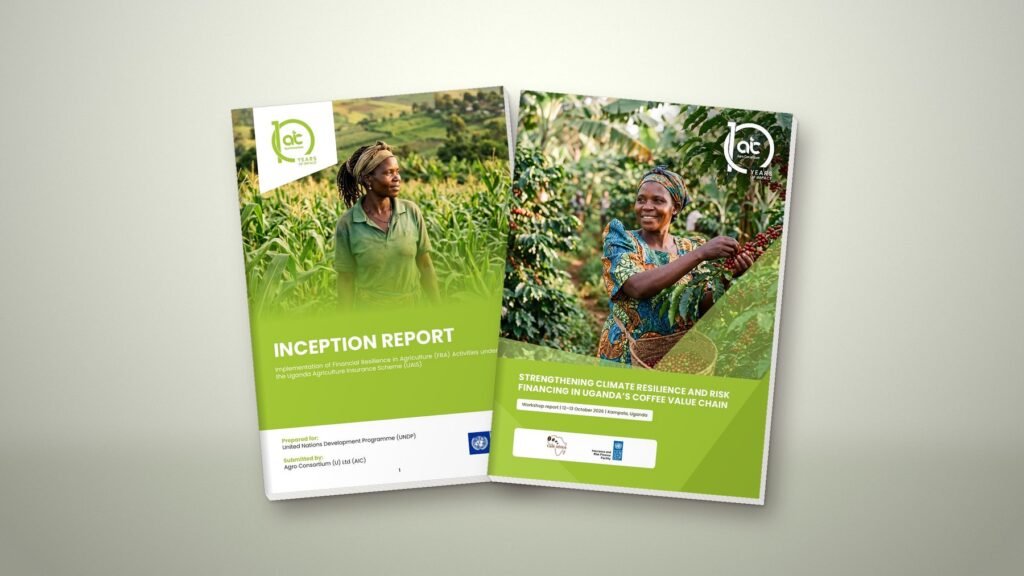
Here is a real example from our own work. For Agro Consortium Uganda (AIC), we designed report templates for its inception report to UNDP and its coffee value chain workshop report. The cover photographs, a maize farmer in her field and a coffee picker at harvest, were generated with AI. They are illustrative images that set the scene for each report, not photos of named participants. Everything else, from the layout and typography to the brand system, is our design.

Where we avoid it
- Logos and brand marks. A logo you cannot protect is a liability, so every mark we design is drawn by a person.
- Images presented as evidence. If a photo claims to show a real programme participant, an actual event or a specific place, it must be a real photograph. An illustrative AI cover is fine; a generated picture passed off as a real beneficiary is not.
- Anything that imitates a living artist, a known character or another brand.
A practical checklist for your next campaign
- Ask your designer which images are AI generated and which are original.
- Keep the core brand assets, such as the logo, pattern and key illustrations, human made and documented.
- Keep a record of prompts, drafts and edits for any AI assisted work you may want to protect later.
- Check the terms of the tool used, especially for commercial and print use.
- Disclose AI use where a funder, publisher or stock platform requires it.
- Check AI images closely for errors: extra fingers, garbled text, wrong flags, uniforms or currency.
Our approach
AI helps us work faster, but it does not replace design judgment or original craft. The work that carries your brand should be original, and any photo that documents your impact should be real. Used that way, AI is a useful assistant rather than a legal risk.
This article is general information, not legal advice. For high value campaigns, speak to an intellectual property lawyer before you publish.
Sources: Pender & Coward, Who owns the rights to AI generated images (April 2026); US Copyright Office guidance on works containing AI generated material.
Found this useful? Share it